Iron Bull 5mm vs 7mm Knee Sleeves: Which Thickness Fits Your Training?
Buying thicker knee sleeves because they look more “serious” is an easy way to end up with the wrong pair.
Iron Bull Strength offers both 5mm and 7mm knee sleeves, and the difference is more useful than it sounds. The 7mm version gives you a firmer, more substantial sleeve around the knee. The 5mm version gives up some of that rigidity in exchange for easier movement.
Neither one wins every category.
If most of your lower-body training is heavy squats, leg presses, and strength work, 7mm is usually the more natural choice. If your sessions move between squats, Olympic lifts, conditioning, and higher-rep work, 5mm may be much easier to live with.
That is really the comparison: not which one looks more like powerlifting gear, but which one gets in your way less during the training you actually do.
Table of Contents
The short answer
If you mainly squat heavy, start with 7mm.
If you want knee sleeves for mixed training and more dynamic movement, look harder at 5mm.
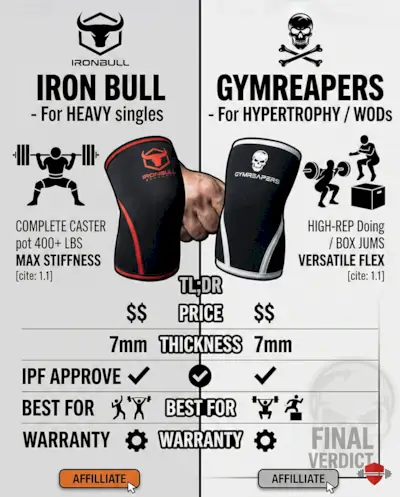
Iron Bull makes essentially the same distinction in its current guidance: 7mm when lifting and squatting are the main goal, and 5mm when greater freedom of movement matters.
| Iron Bull 5mm | Iron Bull 7mm | |
|---|---|---|
| Feel | More flexible | Firmer and more substantial |
| Best fit | Mixed / dynamic training | Squat-heavy strength training |
| Mobility | Higher | Lower |
| Warmth | Moderate | Higher |
| Long sessions | Easier to wear | Can feel bulky |
| Heavy squats | Usable | Better suited |
| First thing to consider | Freedom of movement | Compression and structure |
The table is useful, but your weekly training tells you more than the thickness number does.
When 7mm makes sense
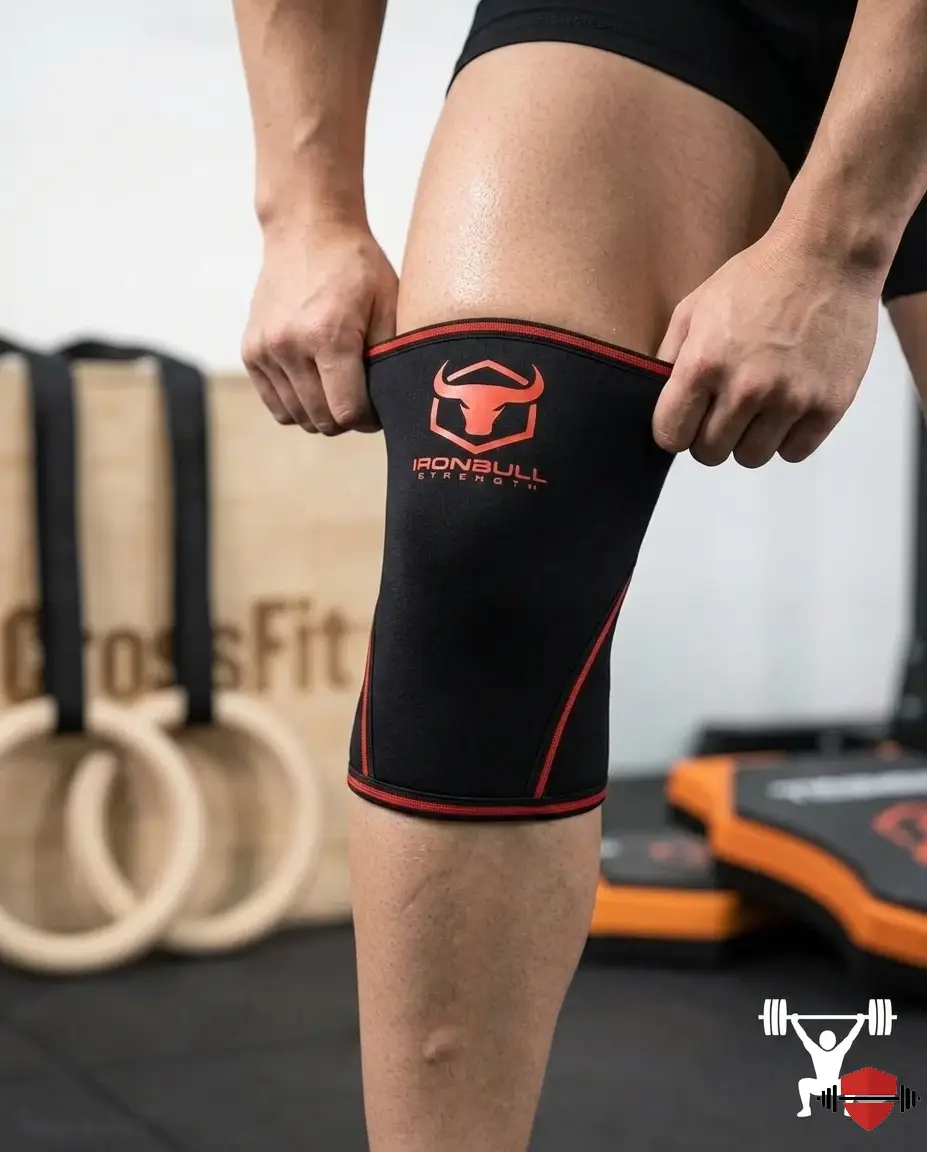
Iron Bull's standard 7mm Knee Sleeves use 7mm SCR neoprene, measure 30cm long, use double-stitched seams, and are sold as a pair. The current product guidance positions them for lifters who put squatting and strength work first.
Say your leg day looks like this: heavy back squats, a few back-off sets, leg press, split squats, then accessories.
A thicker sleeve makes sense there because the session is built around loaded lower-body work. You are not constantly switching between sprinting, jumping, catching a clean, and squatting.
The extra neoprene is noticeable. Seven millimeters holds more heat around the knee and feels more substantial when you bend into a squat. Some lifters like that feeling enough that putting on their sleeves becomes part of the normal squat setup. Others find it unnecessarily bulky.
That is why 7mm should not be the automatic choice simply because you lift weights.
Read our Iron Bull Strength 7mm Knee Sleeves review for construction, fit, sizing, competition status, and day-to-day use.
You can also check the current 7mm Knee Sleeves on Iron Bull Strength or view the 7mm sleeves on Amazon.
As an Amazon Associate, Powerlifting-Gear.pro may earn from qualifying purchases.
Where 5mm starts to make more sense
Five millimeters does not sound dramatically thinner until the workout includes a lot more movement.
Iron Bull's Performance 5mm Knee Sleeves use 5mm neoprene and are designed around a more flexible feel. The model makes more sense when maintaining range of motion matters more than having the firmest possible sleeve around the knee.
Think about a session with front squats, cleans, lunges, box work, higher-rep leg work, or several exercises where you are moving quickly between positions.
A thick 7mm sleeve can still be worn for those things. The question is whether you actually want it there.
With 5mm, you still get neoprene around the knee, but there is less material resisting the bend. That can make the sleeve feel less intrusive over a longer session.
This is why I would not describe the 5mm model as the “weaker” Iron Bull sleeve. It simply solves a slightly different problem.
What about bodybuilding?
This one depends on how you train.
If bodybuilding leg day means heavy hack squats, deep leg presses, and fairly heavy squat variations, 7mm may still feel right.
If it means long sessions, high reps, supersets, walking lunges, and moving between several machines, 5mm is often easier to forget about.
That is an underrated point. A sleeve does not have to provide the maximum possible compression to be useful. Sometimes the better piece of equipment is simply the one you do not feel the need to pull off halfway through the workout.
7mm does not automatically mean a bigger squat
The thicker sleeve is the obvious choice if you want a firmer setup for heavy squats. That is different from saying it will automatically put more weight on the bar.
Knee sleeves provide compression and warmth, and a tight neoprene sleeve can feel different as the knee bends. But the actual effect varies with the sleeve, fit, lifter, and movement.
I would not choose between 5mm and 7mm based on promises of an instant PR.
For most people, the more useful difference is much less dramatic: 7mm feels firmer. 5mm moves easier.
That is enough to make one considerably better than the other for a particular session.
Do not automatically size down
This is one thing worth changing completely from the old version of this article.
Tighter is not automatically better.
Iron Bull's current guidance for the 7mm sleeves is sensible: the sleeve should feel snug and compressive without causing pain, numbness, or interfering with normal movement.
If you fall between sizes, the smaller size can be chosen for a tighter fit, while the larger one gives an easier everyday training fit. That means sizing down is an option, not a rule.
Do not buy a smaller pair simply because somebody says powerlifting sleeves are supposed to be miserable to put on. Measure your leg, check the chart for the exact model, then decide whether you actually want an aggressive fit.
If your foot starts going numb, you have not unlocked a secret level of knee-sleeve performance. Your sleeves are too tight.
What if you compete?
Competition rules deserve their own check rather than assumptions based on thickness.
The standard Iron Bull Strength 7mm Knee Sleeves appear on the current IPF approved-equipment list, while the manufacturer also lists competition certifications for the current 7mm product.
That does not mean every Iron Bull sleeve or every 5mm model should automatically be treated as approved in every federation.
If you are buying sleeves specifically for a meet, check the exact model against the current federation rules before ordering. For normal gym training, this matters much less.
Neither sleeve is a treatment for knee pain
You will see aggressive pain-relief language around knee sleeves online. I would not use that as a reason to choose 5mm or 7mm.
Both are pieces of training equipment. They can provide compression, keep the knee area warmer, and change how supported the joint feels while you lift. They do not diagnose why a knee hurts.
If you are choosing between the two simply because one of your knees has started hurting, the thickness of the neoprene probably is not the first question that needs answering.
So, 5mm or 7mm?
If your training revolves around squats and heavy lower-body strength work, I would choose the Iron Bull 7mm Knee Sleeves.
If your week includes Olympic-style lifting, conditioning, higher reps, or a lot of movement between exercises, the 5mm sleeves are easier to justify.
And if your training falls somewhere in between, look at the part of the workout where you actually want the sleeves.
If you mainly put them on for squats and remove them afterward, 7mm. If you want to put them on and leave them there while the workout changes around you, 5mm deserves a serious look.
That is a much more useful way to choose than buying the thickest sleeve available.
Bottom line
Iron Bull 5mm and 7mm Knee Sleeves are not really competing to do exactly the same job.
The 7mm model is the more squat-focused option: thicker, warmer, and more substantial around the knee.
The 5mm model gives you more movement and makes more sense when your workouts are less specialized.
For a powerlifter whose lower-body training revolves around heavy squats, I would start with 7mm. For someone doing mixed strength work, Olympic lifts, conditioning, or long sessions where mobility matters, I would seriously consider 5mm.
Neither choice needs a dramatic explanation. Pick the thickness that fits the training you actually do.
FAQ
Are 7mm knee sleeves better than 5mm?
Not universally. Seven-millimeter sleeves provide a thicker, firmer feel and are usually better suited to squat-heavy strength training. Five-millimeter sleeves allow more movement and can be easier to use during mixed or dynamic workouts.
Should powerlifters choose 7mm?
For most squat-focused powerlifting training, 7mm is the more obvious starting point. Competition lifters should also check that the exact model appears on the current equipment list for their federation.
Are 5mm sleeves only for beginners?
No. Sleeve thickness is about training use, not experience level. An experienced weightlifter or mixed-training athlete may deliberately choose 5mm because it allows more movement.
Should I size down in Iron Bull knee sleeves?
Not automatically. Use the size chart and choose the smaller size only if you specifically want a tighter fit when between sizes.
Can knee sleeves prevent knee injuries?
They should not be treated as guaranteed injury prevention. Their straightforward functions are compression, warmth, and a more supported feeling while training.
Sources for this article
- Iron Bull Strength — 7mm Knee Sleeves
- Iron Bull Strength — Performance 5mm Knee Sleeves
- Iron Bull Strength — 5mm vs 7mm Knee Sleeves guide
- Iron Bull Strength — Knee Sleeves collection and buying guidance
- International Powerlifting Federation — Approved Equipment List
- Powerlifting-Gear.pro — Iron Bull Strength 7mm Knee Sleeves review
- Amazon — Iron Bull 7mm Knee Sleeves
- Amazon — Iron Bull 5mm Knee Sleeves
Adapted and fact-checked: August 19, 2026.