Knee Sleeve Sizing Guide: Training Fit vs Competition Fit
Knee sleeve sizing gets weird fast.
You measure your knee.
You open the size chart.
You land comfortably in Large.
Then somebody at the gym tells you they wear Medium.
Another lifter says competition sleeves should take ten minutes to put on.
A third person is using what looks like the same sleeve in your size and pulling it on without any drama at all.
So now you're wondering whether you bought the wrong pair because yours actually fit.
You probably didn't.
A powerlifting knee sleeve can fit several different ways depending on what you want from it.
A training fit should be secure, supportive and easy enough to use regularly.
A competition fit may be noticeably tighter.
But there is a point where “tight” stops being useful and becomes a sizing problem.
The goal is not to buy the smallest sleeve that will eventually go over your calf.
The goal is to buy the sleeve that works for your knee, your leg shape and the way you actually train or compete.
Table of Contents
Start With the Manufacturer's Size Chart
This sounds boring because it is.
It is also the best place to start.
Different knee sleeves are cut differently.
A Medium from one brand can fit nothing like a Medium from another.
Some models have a relatively straight cylindrical cut.
Others taper more aggressively.
Some are designed around very stiff neoprene and feel smaller even when the published measurements look similar.
That means advice such as:
“I weigh 198, buy a Medium”
is almost useless.
Bodyweight does not tell you enough.
Two lifters at the same bodyweight can have completely different knee, calf and quad measurements.
Use the chart for the exact sleeve you're buying.
Then decide whether you actually need to deviate from it.
Where Should You Measure for Knee Sleeves?
Follow the brand's instructions first.
Most sizing systems ask for a circumference measurement around the knee, often with the leg straight or relaxed.
Some brands also use calf measurements.
That second number matters more than people expect.
A sleeve does not teleport onto your knee.
It has to pass over your calf first.
If you have a relatively small knee joint and very large calves, sizing only from the knee can give you a sleeve that theoretically fits once it reaches the right position but is miserable to get there.
The opposite can happen too.
A lifter with slim calves and a larger knee circumference may have little trouble getting the sleeve on but still need more room around the joint.
This is why leg shape matters.
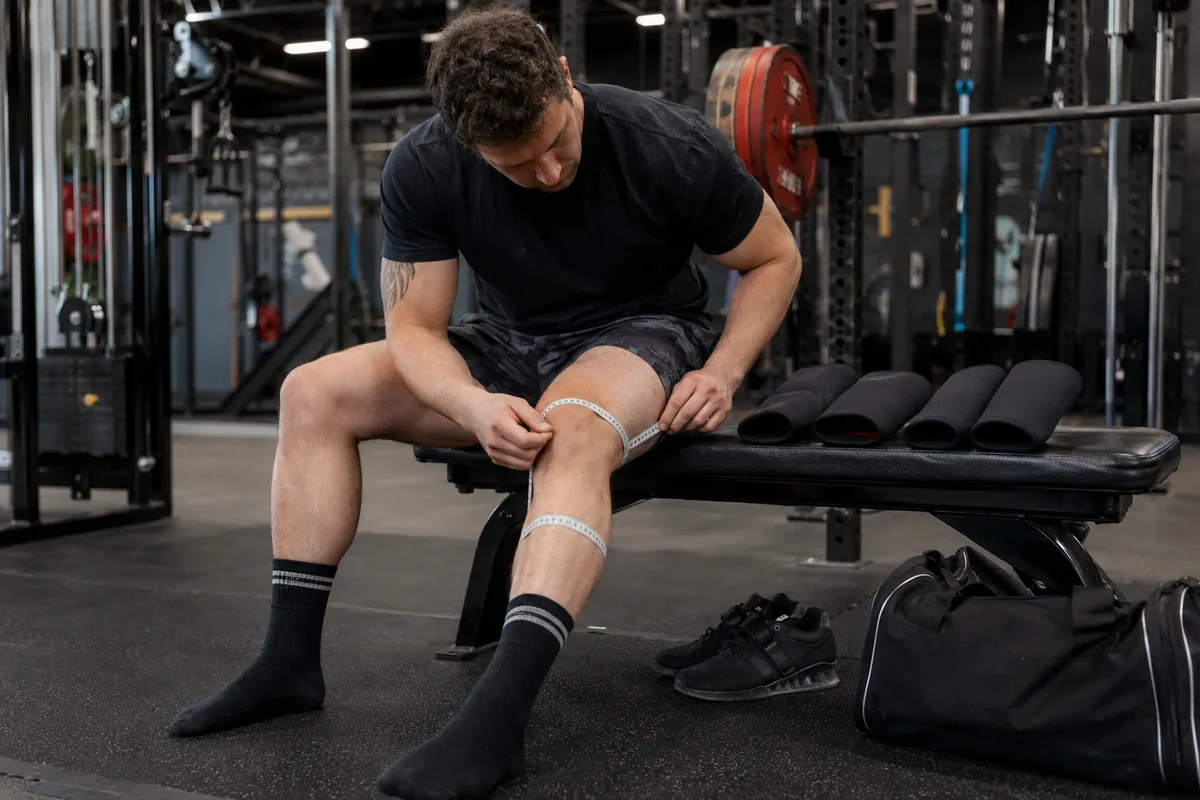
How to Measure Your Knee
Use a soft measuring tape.
Stand naturally.
Keep the leg relaxed unless the manufacturer tells you otherwise.
Wrap the tape around the knee at the location specified in the size chart.
Do not pull the tape hard enough to compress the leg.
You are measuring your knee, not trying to make the number smaller.
Record the measurement.
Then do the other knee.
Most people will be similar side to side, but not everyone is.
If there is a meaningful difference, size for the larger measurement unless the manufacturer gives different guidance.
Measure Your Calf Too
Even when a chart doesn't require it, calf circumference can tell you a lot about how difficult a sleeve will be to put on.
Measure around the largest part of the calf.
If your calf is large relative to your knee measurement, be cautious about aggressively sizing down.
A sleeve can feel perfect once it reaches the knee and still be a terrible choice if every training session begins with a wrestling match against your lower leg.
Competition changes that calculation a little.
Training changes it a lot.
What Does a Normal Training Fit Feel Like?
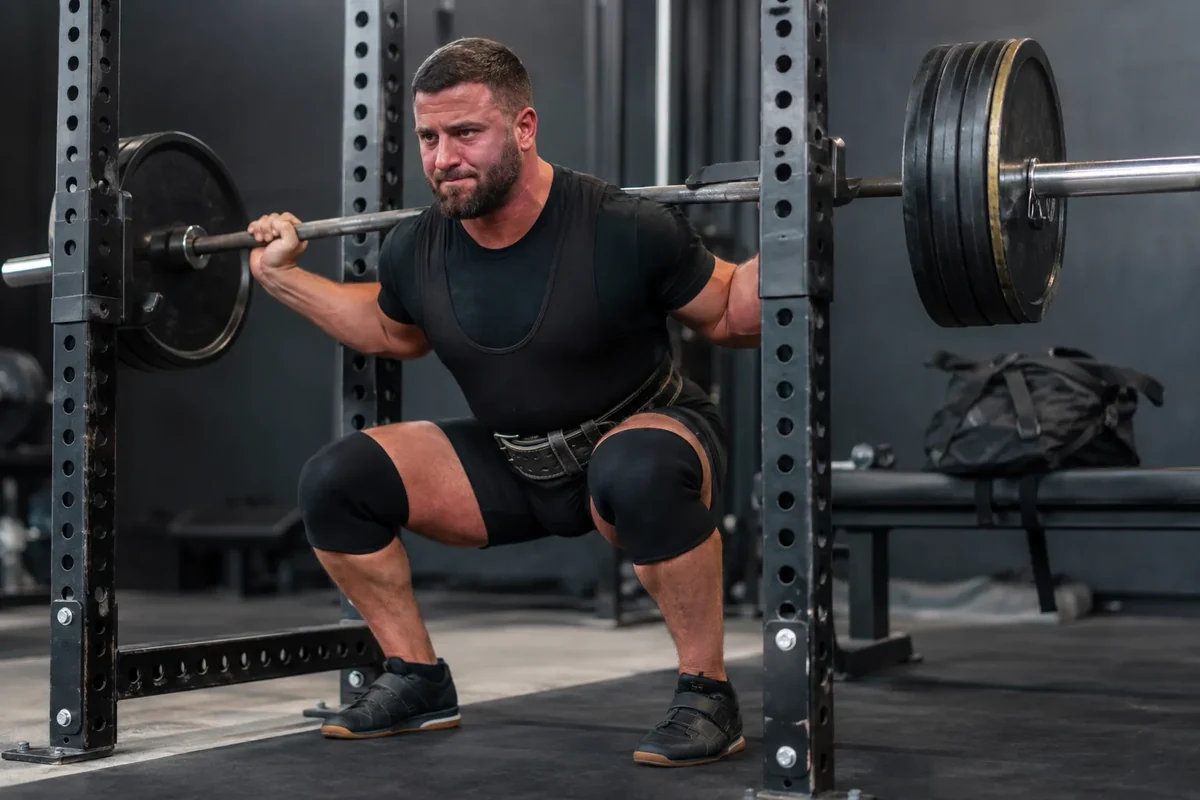
A training knee sleeve should feel snug.
It should stay in position.
It should provide noticeable warmth and compression.
It should not slide down every time you walk between sets.
But you should be able to put it on without turning the first fifteen minutes of your workout into a separate sport.
For most lifters, a useful training fit means:
- noticeable compression around the knee
- little or no bunching
- no constant slipping
- enough room that you can get the sleeve on consistently
- no numbness or tingling
- no major distraction while walking, warming up or sitting between sets.
You should feel the sleeve.
You should not spend the whole session thinking about it.
That is usually a good sign.
What Does a Competition Fit Feel Like?
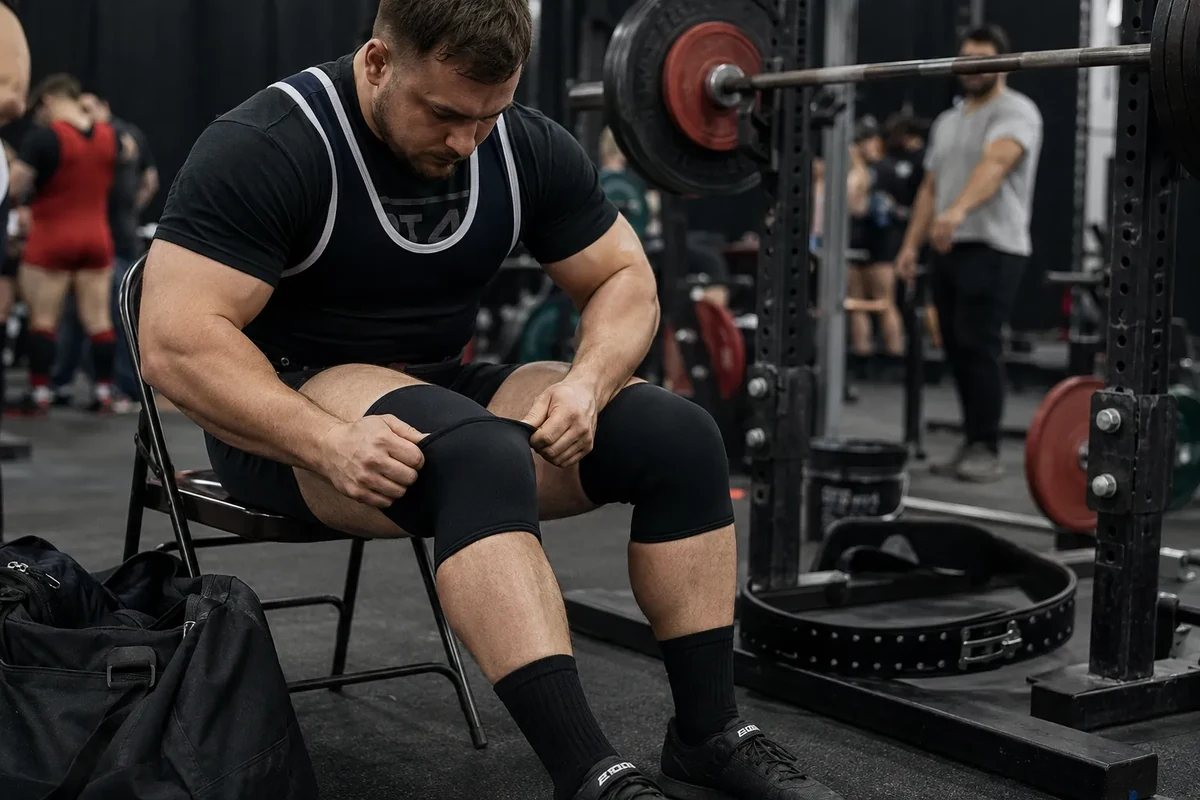
Competition fit is where people start pushing sizing harder.
A tighter sleeve can feel more secure.
Stiff 7 mm models can create a very different sensation from a softer training sleeve even at the same nominal size.
Some lifters deliberately choose a smaller size for competition because they prefer the tighter compression and stronger feel around the knee.
That can make sense.
But “competition fit” does not mean:
unwearable.
You still need to get the sleeve on.
You still need it positioned correctly.
You still have to warm up.
You still have to walk around a venue.
You still have to get through three squat attempts without the sleeve becoming the only thing you can feel.
A competition sleeve can be inconvenient.
It should not be absurd.
Should You Size Down?
Sometimes.
Not automatically.
This is probably the most abused piece of knee-sleeve advice.
If the manufacturer's chart puts you near the lower edge of a size and you already know you like a very tight sleeve, sizing down may work.
If you're right in the middle of the recommended range and have large calves, dropping a full size can turn a perfectly useful sleeve into something you barely use.
And if you're already at the upper end of the chart, sizing down because a stranger online said “real powerlifters size down” makes even less sense.
Start with the chart.
Then use your actual goal.
One Size Down Is Not a Universal Competition Rule
There is no federation rule saying competition knee sleeves must be one size smaller than training sleeves.
That is a preference some lifters use.
It is not a requirement.
The IPF regulates the sleeve itself — its approved status, construction, thickness, length and how it is worn.
It does not require you to buy a smaller size than the manufacturer recommends.
So if your chart size gives you the fit you want, you are not “doing competition sleeves wrong.”
You are just wearing the correct size.
When Sizing Down Can Make Sense
Sizing down is most reasonable when several things are true at once.
You already have experience with knee sleeves.
You know you prefer a very tight fit.
Your measurements sit close to the boundary between two sizes.
Your calves are not dramatically larger than the size chart assumes.
And the sleeve you're buying is not already known for an extremely aggressive cut.
That last part matters.
Sizing down in a soft training sleeve and sizing down in a very stiff competition sleeve are not the same decision.
When You Probably Shouldn't Size Down
If this is your first pair of knee sleeves, normal sizing is usually the smarter starting point.
The same goes if:
- your calf is large relative to your knee
- you train alone and struggle to position tight sleeves
- you want one pair for every squat session
- you have hand or grip limitations that make sleeve application difficult
- you're already near the top of the recommended range
- you hate taking equipment on and off between sets
- you know you value comfort over maximum compression.
A sleeve you avoid wearing is not a good training sleeve.
Training Sleeves and Competition Sleeves Can Be Different Pairs
You do not have to make one pair do everything.
Plenty of lifters use a comfortable pair for regular training and save a tighter or stiffer pair for heavy singles and competition.
That has some practical advantages.
Your training pair sees the daily wear.
You can get it on quickly.
You do not need assistance every session.
Your competition pair stays in better condition and only comes out often enough that you remain comfortable using it.
This is not mandatory.
A lot of lifters happily train and compete in one pair.
But if your ideal competition fit is annoying for ordinary volume work, two pairs can make more sense than forcing one compromise.
Stiffness Changes How the Same Size Feels
This is one of the biggest reasons online sizing advice gets messy.
Two sleeves can both be:
- 7 mm thick
- the same nominal size
- the same general length
and still feel completely different.
Neoprene stiffness, panel shape, seam placement and overall construction change how much the sleeve resists stretching.
A very stiff sleeve can feel dramatically tighter than a softer model even when both size charts say Large.
That means:
size is only part of fit.
Stiffness is the other part.
If you're moving from a flexible training sleeve to one of the very stiff competition-focused models, do not assume you need to size down just because you did it with the softer pair.
You may already be getting the tighter feel you wanted from the construction itself.
The 2025–2026 Stiff Sleeve Situation Makes Model Choice More Important
This matters particularly for IPF lifters right now.
In 2025, the IPF initially announced the removal of several very stiff knee sleeve models.
That decision was later reversed for six models, and those sleeves were permitted to continue in IPF-sanctioned competition through the end of 2026.
That history is useful for one reason:
do not buy a competition sleeve based only on reputation or old forum advice.
Check the exact model and current status.
A sizing guide cannot tell you whether a product is currently eligible.
The federation can.
How Tight Is Too Tight?
This is the question people usually answer badly.
“Painful is good.”
Not necessarily.
A very tight competition sleeve can be uncomfortable.
That does not mean every kind of discomfort is useful.
Signs that the fit may be too aggressive include:
- persistent numbness
- tingling
- the foot changing color
- severe pressure that does not settle after positioning
- inability to bend the knee normally enough to warm up
- the sleeve folding or bunching because it cannot sit correctly
- repeated difficulty getting it fully centered over the joint
- skin damage every time you use it.
At some point you are no longer getting “more competition fit.”
You are just wearing a sleeve that is too small for you.
Your Foot Should Still Feel Like Your Foot
A tight sleeve can leave temporary marks.
That is not unusual.
What you do not want is losing normal sensation in the lower leg or foot.
If your toes are going numb before you've even touched a squat bar, loosen the situation by taking the sleeve off and reassessing the fit.
A knee sleeve is supportive equipment.
It is not supposed to turn circulation management into part of your attempt selection.
How Long Should It Take to Put Knee Sleeves On?
There is no correct number of minutes.
A comfortable training pair may take seconds.
A tight competition pair may take much longer.
That alone does not make one better.
If a sleeve goes on easily, sits correctly and gives you the support you want, there is no hidden powerlifting rule saying you should make the process harder.
The relevant question is:
Can you get it on reliably when you need it?
At a competition, timing matters.
Warm-up rooms are busy.
Flights move.
You do not want to discover that your competition sleeves require a technique you have never practiced. If application is the problem rather than sizing, see our guide to putting on tight knee sleeves.
Don't First-Test a Tight Size on Meet Day
Wear the sleeves in training.
Not just once.
You need to know:
- how long they take to put on
- whether you can position them correctly
- whether they shift during squats
- how they feel after multiple warm-up sets
- whether you want to remove them between attempts
- how difficult they are to take off afterward.
A sleeve that felt impressive during a single test squat in your living room may be much less charming after forty minutes in a warm-up area.
Where Should the Sleeve Sit?
Under current IPF rules, knee sleeves are centered over the knee joint.
For standard singlets, the sleeve also must not improperly contact the singlet or socks.
That means sizing has to work in the correct position.
A sleeve that is so small you cannot pull it high enough to center properly is not a good competition fit.
Neither is one that keeps sliding down below the knee.
The correct sleeve needs to stay where the rules require it.
Can Knee Sleeves Touch the Singlet?
For normal IPF singlet setups, the sleeve and singlet should not be in prohibited contact.
The 2026 rules now also address approved long-legged singlets separately, including permitting sleeves over those singlets rather than underneath them.
For most Classic lifters using the standard short-leg singlet, the practical picture remains simple:
you should normally see some thigh between the top of the knee sleeve and the bottom of the singlet leg.
This is another reason not to buy sleeves so tight that you cannot position them properly.
What About Socks?
Sock position matters too.
Under standard IPF rules, knee sleeves should not improperly contact the socks.
Long deadlift socks belong to the deadlift setup, but your squat knee-sleeve setup still needs to comply with the relevant placement rules.
If you use socks to help put tight sleeves on, position everything correctly once the sleeve reaches the knee.
The getting-it-on method and the final competition position are two different things.
IPF Knee Sleeve Rules for 2026
For current IPF competition, knee sleeves are limited to:
- 7 mm maximum thickness
- 30 cm maximum length
They must be continuous cylinders.
They cannot have:
- straps
- Velcro
- drawstrings
- added padding
- similar extra supportive devices.
They must also come from manufacturers accepted under the IPF Approved List system and satisfy the current technical rules.
So just like sizing, legality is model-specific.
A 7 mm sleeve is not automatically an IPF competition sleeve.
Can Someone Help You Put Tight Knee Sleeves On?
The current 2026 rulebook explicitly states in the knee-sleeve section that athletes may receive personal assistance when applying sleeves.
The inspection section contains awkward overlapping wording but again includes a line allowing personal assistance.
What is clear is that certain methods are not permitted.
Plastic sliding devices and lubricants are specifically identified as prohibited.
Socks are permitted as an aid.
For meet day, use a normal method you have already practiced and follow the referees or Technical Controller if they give instructions. Our 2026 equipment inspection guide covers the wider gear-check process.
Do not improvise with a plastic bag and hope nobody notices.
How to Size If You Have Big Calves
This is where knee-only sizing causes the most frustration.
Suppose your knee measurement puts you comfortably in Medium.
But your calf is much larger than average for that size.
A tight Medium may reach the knee only after an enormous amount of effort.
A Large may still fit the joint very securely while being far easier to use.
In that case, the larger sleeve can be the better fit even if the knee measurement alone seems to suggest otherwise.
The best competition sleeve is not the one with the most impressive struggle video.
It is the one you can get into the correct position while still getting the compression you want.
How to Size If You Have Large Quads
Quad size usually matters less during the initial pull over the calf, but it affects the top opening and how the sleeve sits once positioned.
If the upper edge is painfully cutting into the lower quad while the knee itself feels fine, the sleeve's taper may not match your leg shape.
Going up a size can help.
Changing models can help even more.
Not every sleeve shape works equally well for every leg.
If You're Between Sizes
Being between sizes is where personal preference actually matters.
Choose the larger size when you want:
- easier daily use
- less aggressive compression
- simpler warm-ups
- a first pair of sleeves
- more tolerance for large calves.
Choose the smaller size when you want:
- a very tight fit
- competition-focused compression
- you already know how that model behaves
- your measurements are safely within the manufacturer's smaller-size recommendation or close enough that the brand itself suggests the option.
Do not turn a close sizing decision into a toughness contest.
There are no points for ordering the smaller box.
What If Your Weight Changes?
Knee sleeve fit can change more than you expect after a significant bodyweight change.
Gain bodyweight and your calves, quads and knee circumference may increase.
Lose bodyweight and an old competition sleeve may become noticeably easier to put on.
This is especially relevant if you bought tight sleeves while competing in a different weight class.
Re-measure.
Do not assume a size you used two years ago is still automatically right.
New Sleeves Often Feel Tighter
A new sleeve can feel significantly different from the same model after months of use.
Neoprene softens somewhat with repeated stretching, sweat, washing and normal wear.
That does not mean you should buy a sleeve that is completely unmanageable because “it will break in.”
But it does mean a brand-new pair may feel firmer than it will after several sessions.
Use the sleeve.
Let the material settle naturally.
Do not try to artificially destroy the stiffness in one evening.
Don't Stretch New Sleeves Over Random Objects
You'll see people suggest leaving tight sleeves stretched over bottles, dumbbells or other objects overnight.
That may make them easier to put on.
It can also change the fit you intentionally paid for and stress the seams or material.
If the sleeve is genuinely the wrong size, stretching it into another size is a strange way to solve the problem.
Exchange it if you can.
Should You Fold the Sleeve to Put It On?
Many lifters fold or invert part of a tight sleeve during application.
That can make the material easier to grip and lets you move it up the leg in stages.
The exact method depends on the sleeve and your leg shape.
The important thing is what the sleeve looks like once it is on.
It should be:
- fully unfolded
- centered over the knee
- sitting flat
- not twisted
- not rolled into a thick band.
The putting-on technique is temporary.
The final position is what matters.
Training Fit vs Competition Fit: A Simple Comparison
| Training Fit | Competition Fit | |
|---|---|---|
| Putting them on | Relatively quick | May take more effort |
| Compression | Firm | Very firm |
| Comfort between sets | Higher | Usually lower |
| Good for frequent volume | Usually yes | Depends on lifter |
| Sizing down | Usually unnecessary | Sometimes useful |
| Warm-up convenience | Easy | Requires more planning |
| Best use | Regular training | Heavy singles / meet day |
This is not a rulebook table.
It is a practical way to think about the trade-off.
Some lifters prefer competition-tight sleeves every day.
Others want nothing to do with them until the meet is close.
Both approaches can work.
One Pair for Everything: What I Would Choose
If I were buying only one pair, I would bias toward a fit that I could actually train in.
That means secure enough for heavy squats but not so tight that I avoid putting it on.
Why?
Because familiarity matters.
The sleeve you have used for dozens of squat sessions is predictable.
You know how it sits.
You know how it feels at depth.
You know how long it takes to put on.
A theoretically more aggressive size is not automatically better if you barely practice in it.
Two Pairs: What I Would Choose
If you're comfortable buying separate pairs, the split is simple.
Training pair: normal chart size, comfortable enough for volume.
Competition pair: tighter or stiffer model, after confirming current federation approval and practicing with it before the meet.
That gives you convenience most of the year without giving up the tighter setup you may prefer for heavy singles.
Again, you do not need two pairs to be serious about powerlifting.
It is just one practical option.
A Simple Home Sizing Test
When the sleeves arrive, do more than stand in them.
Put Them On Without a Workout
Can you get them to the correct position?
Walk Around
Do they stay centered?
Bend the Knee
Do they fold strangely behind the joint?
Do a Bodyweight Squat
Does the sleeve stay flat?
Do a Warm-Up Set
Now you start getting useful information.
Work Up to a Meaningful Squat
The sleeve should be tested while you're actually bracing and squatting the way you train.
Leave Them On for a Few Minutes
A sleeve that feels fine for ten seconds may feel completely different after multiple sets.
Then decide.
Do not decide sizing based only on how difficult the first thirty seconds were.
Signs the Size Is Probably Right
A good fit usually looks boring.
You can get the sleeve on with a repeatable method.
It reaches the correct position.
It stays centered.
It does not constantly slide.
You can squat normally.
The pressure feels useful rather than alarming.
You are willing to wear it again.
That last one matters more than people admit.
Signs You May Need to Size Up
Consider a larger size if:
- you repeatedly cannot get the sleeve over the calf
- you cannot position it correctly over the knee
- your foot or lower leg goes numb
- the top opening causes extreme pressure
- you're damaging the sleeve during normal application
- you avoid using the pair because putting it on is too much work.
Sizing up is not failing at powerlifting.
It is buying equipment that fits.
Signs You May Need to Size Down
A smaller size may make sense if:
- the sleeve slides down during sets
- the material visibly gaps around the knee
- compression is much lighter than you wanted
- your measurements have dropped after weight loss
- you're clearly at the small end of the manufacturer's range.
Before ordering smaller, make sure the problem is actually size.
A worn-out old sleeve can also feel loose.
So can a softer model when you were expecting a very stiff one.
Competition Week Is Not the Time to Change Sizes
If your current sleeves are working, do not order an aggressively smaller pair six days before the meet because somebody told you they might add five pounds to your squat.
You have no idea whether you can put them on.
You have no idea how they affect depth.
You have no idea how your warm-up timing changes.
Equipment experiments belong in training.
Meet week should be boring.
Frequently Asked Questions
How tight should powerlifting knee sleeves be?
They should fit firmly around the knee and stay in place without causing persistent numbness, tingling or preventing normal squat movement.
Competition-focused lifters may prefer a considerably tighter fit than they use for regular training.
Should I size down in knee sleeves?
Not automatically.
Use the exact manufacturer's size chart first. Sizing down can make sense for experienced lifters seeking a tighter competition fit, but calf size, sleeve stiffness and individual leg shape matter.
Should competition knee sleeves be smaller than training sleeves?
They can be, but they do not have to be.
Many lifters use tighter sleeves for competition, while others train and compete in the same size.
Do knee sleeves stretch over time?
They can soften and become somewhat easier to put on with repeated use.
That does not mean an obviously wrong size should be purchased with the expectation that it will eventually become comfortable.
How do I measure for knee sleeves?
Follow the manufacturer's specific chart. Most use circumference around the knee, and some also require or benefit from a calf measurement.
Should I measure both knees?
Yes.
If the measurements differ, sizing for the larger knee is usually the safer starting point unless the manufacturer says otherwise.
Why can't I get my knee sleeves over my calves?
Your calf circumference may be large relative to the knee size you selected, or the sleeve may simply be too small or too stiff for your leg shape.
Can someone help put on my knee sleeves at an IPF meet?
The 2026 Technical Rulebook states that athletes may receive personal assistance when applying knee sleeves. Follow the officials' instructions at your specific meet.
Can I use a plastic bag to put on IPF knee sleeves?
No. The current rulebook identifies plastic sliding devices as prohibited.
Can I use socks to help put knee sleeves on?
Yes. The current IPF rulebook specifically permits socks as an aid for applying knee sleeves.
What is the maximum IPF knee sleeve thickness?
The current maximum is 7 mm.
What is the maximum IPF knee sleeve length?
The current maximum is 30 cm.
Do knee sleeves have to be IPF approved?
For IPF competition, yes. The exact sleeve needs to satisfy the current Approved List and technical requirements.
Are extra-stiff knee sleeves legal in IPF competition in 2026?
Some specific stiff models affected by the 2025 IPF decision were later permitted to continue through the end of 2026.
Check the exact model and current IPF notice rather than assuming every stiff sleeve has the same status.
Should I buy one pair for training and another for competition?
You do not need to.
But if you prefer very tight competition sleeves and more comfortable sleeves for regular volume work, using separate pairs can be practical.
Buy the Fit You'll Actually Use
There is always somebody wearing smaller knee sleeves than you.
That does not make their size better.
Start with measurements.
Use the exact manufacturer's chart.
Think about your calf as well as your knee.
Decide whether you are buying for daily training, competition or both.
And remember that a competition fit still has to function like equipment.
You need to get it on.
You need to position it correctly.
You need to squat in it.
If the sleeve does those things and gives you the compression you want, the size label has already done its job.
You can stop arguing with it.