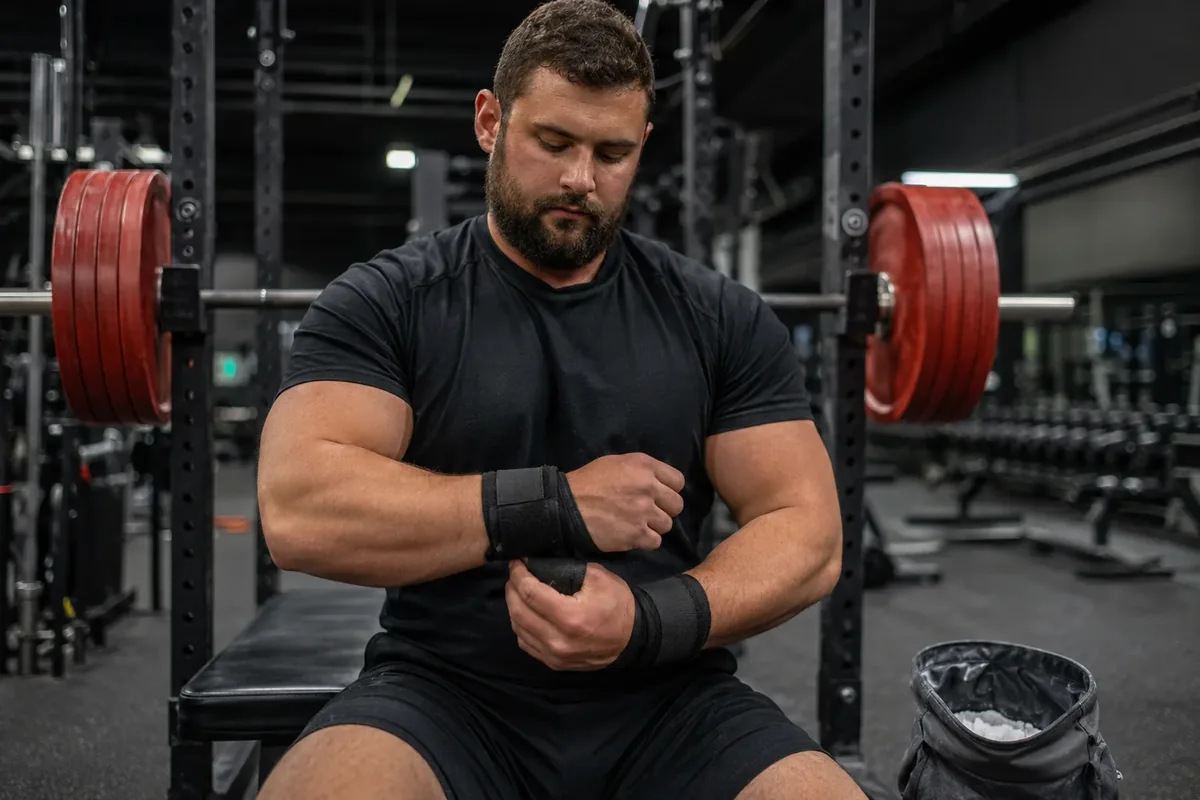
How to Wear Wrist Wraps for Powerlifting: Position, Tightness & IPF Rules
Wrist wraps are easy to use badly.
You can wrap them so low that they barely support the joint. You can crank them down until your fingers start tingling. You can cover half your hand and discover at equipment inspection that your competition setup doesn't meet the rules.
Or you can spend ten seconds wrapping each wrist, forget about them, and bench.
That's usually the goal.
A good wrist wrap should reduce unwanted wrist extension without turning your hand into a rigid club. How high you place it, how much tension you use, and how stiff the wrap itself is all change how it feels.
And for competition, there is another consideration: the way you like to wear a wrap in the gym still has to fit your federation's rules.
Here's how to get the useful part without making wrist wraps more complicated than they need to be.
Table of Contents
What Wrist Wraps Actually Do
A wrist wrap supports the wrist joint by limiting how far it can extend under load.
Think about a heavy bench press.
The bar is sitting in your hand while hundreds of pounds of force are trying to push the wrist backward. Ideally, the bar, wrist and forearm are stacked reasonably well.
In reality, very few lifters maintain a perfectly straight wrist under a heavy bar.
Some extension is normal.
The problem is when the wrist keeps folding backward farther than you want it to.
A properly placed wrap gives you something firm to brace against. It does not hold the bar for you, and it does not replace a good grip.
That is why wrist wraps and lifting straps are completely different pieces of equipment even though both are worn around the wrist.
Wrist wraps support the joint.
Lifting straps help maintain your grip on the bar.
If your hands are opening during a deadlift, tighter wrist wraps are not the solution.
Where Should a Wrist Wrap Sit?
This is the first thing to fix if your wraps don't seem to do much.
A powerlifting wrist wrap should cross the wrist joint.
Not just the forearm.
If every layer is wrapped around the narrow part of your lower forearm and the actual wrist joint is left exposed, you've basically made yourself a very tight sweatband.
You want part of the wrap below the joint and part above it toward the hand.
That creates the support you're looking for.
You do not need to cover half your palm.
The exact position depends a little on your wrist anatomy, the width of the wrap and how much restriction you prefer.
A useful starting position is to have the upper edge of the wrap sit close to the base of the hand while the body of the wrap crosses the wrist crease.
From there, adjust.
If the wrist still collapses backward easily, move the wrap slightly higher or use more tension.
If you can't grip the bar comfortably, you've probably gone too far.
High Wrist Wrap Placement vs Low Placement
Lifters sometimes talk about “high” and “low” wrapping as though they are completely different techniques.
They're really points on a spectrum.
Higher Placement
Moving the wrap higher toward the hand generally creates more resistance to wrist extension.
This is popular for heavy bench pressing because it can make the wrist feel much more locked in.
The trade-off is freedom of movement.
Go too high and you may find it harder to:
- close your hand naturally;
- set your grip;
- position the bar comfortably;
- move the thumb;
- comply with competition coverage limits.
More coverage is not automatically better.
Lower Placement
A slightly lower wrap leaves the hand freer and may feel more comfortable during general training.
It can work well for lifters who don't need much support or who dislike the feeling of a heavily restricted wrist.
Move it too low, though, and the wrap stops crossing enough of the joint to do its job.
If you're wrapping tightly and still wondering why your wrist bends back almost exactly as it did without wraps, look at placement before buying a stiffer pair.
How Tight Should Wrist Wraps Be?
Tight enough to provide support.
Not tight enough to make you question whether your fingertips are still part of your body.
That sounds obvious, but wrist wraps are one of those pieces of equipment where lifters often assume more discomfort means more support.
It doesn't.
For normal training, you should generally be able to wear the wrap through the set without numbness, tingling or intense pressure.
Competition wrapping can be tighter because you only need the setup for a short attempt.
Even then, tighter has a useful limit.
If your hand feels weak because you've compressed the wrist so aggressively that your grip is affected, the wrap is working against you.
A good test is simple.
Wrap the wrist the way you normally would, then make a hard fist.
You should feel the wrap resisting extension while still being able to close the hand normally.
If you cannot grip naturally, back it off.
You Don't Need the Same Tightness for Every Set
One of the easiest ways to make wrist wraps annoying is to put them on at competition tension for your first warm-up.
You don't need that.
For lighter sets, many lifters either skip wraps entirely or wear them loosely.
As the weight increases, tighten them.
For example, your progression might feel something like this:
Early warm-ups: no wraps.
Middle warm-ups: wraps on, moderate tension.
Heavy warm-ups and work sets: normal training tension.
Heavy single or competition attempt: firmer competition-style wrap.
There is no required sequence.
The point is that wrist wraps are adjustable equipment.
Use that.
You do not get extra adaptation points for cutting off circulation during a 135-pound bench warm-up.
How to Put Wrist Wraps On
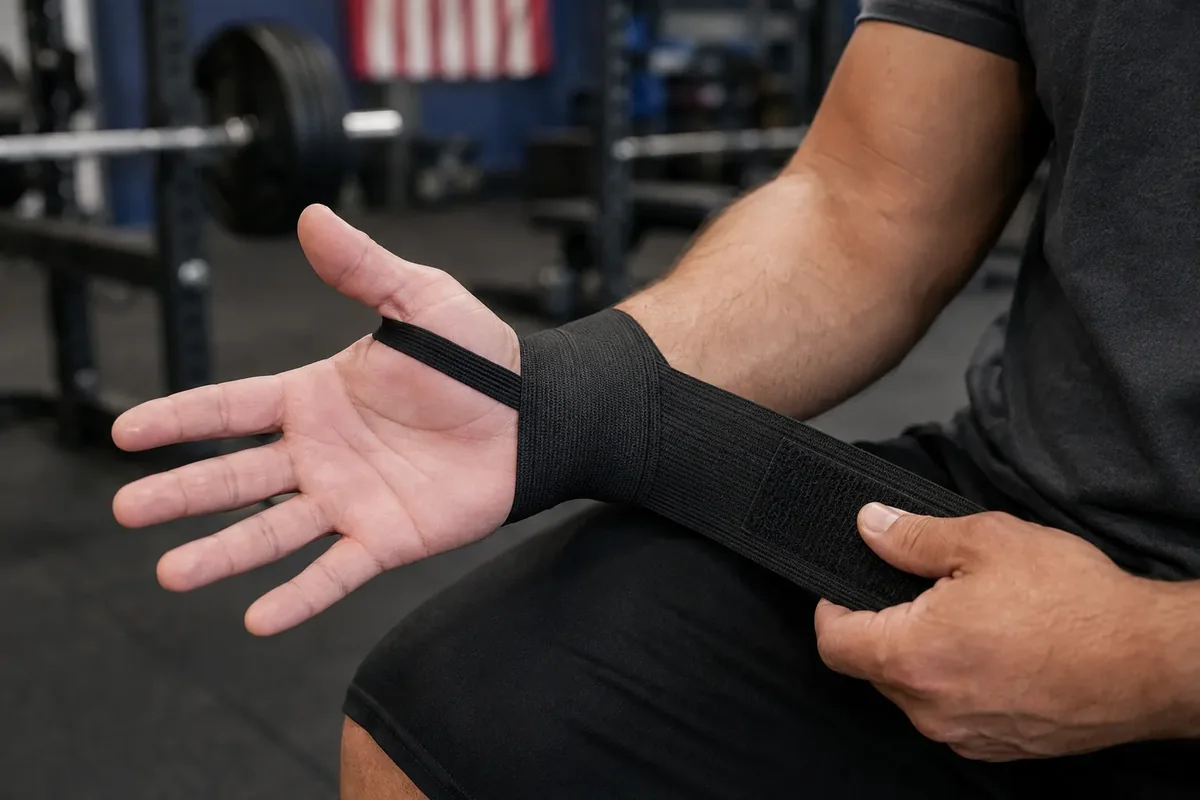
Most powerlifting wrist wraps use a thumb loop on one end and Velcro on the other.
The basic process is straightforward.
1. Find the Thumb Loop
Put the loop over your thumb.
It is there to help anchor the first part of the wrap while you start winding it.
Make sure the wrap is oriented so the Velcro will finish correctly rather than discovering at the end that the fastening surface is facing inward.
Every pair feels obvious after you've used it a few times.
The first attempt can feel like folding a fitted sheet.
2. Start Across the Wrist Joint
Bring the first layer across the wrist rather than placing the whole thing far down your forearm.
That first pass helps establish where the rest of the wrap will sit.
3. Build Tension Gradually
Pull the wrap firm as it goes around.
You do not need to use maximum tension on the first rotation.
For many lifters, increasing the pull slightly as the wrap builds creates a more comfortable setup than violently stretching every pass.
4. Overlap the Layers
Each rotation should overlap the previous one enough to create a stable wrap.
Avoid making a tall spiral that leaves large gaps.
You're building one supportive structure around the joint.
5. Finish With the Velcro
Secure the Velcro firmly.
The end should lie flat rather than hanging loose where it can catch on the bar or your clothing.
6. Remove the Thumb Loop Before the Lift if Your Rules Require It
Under current IPF rules, the loop may be used to help secure the wrap, but it cannot remain over the thumb or fingers during the actual lift.
That means you wrap with the loop, secure the Velcro, then pull the loop off your thumb before stepping onto the platform.
This is easy to practice and very easy to forget if you never do it in training.
Which Direction Should You Wrap?
There is no universal law that every lifter must wrap clockwise on one wrist and counterclockwise on the other.
The practical question is whether the direction helps the wrap sit securely and whether you can reproduce it consistently.
Some lifters prefer wrapping inward toward the thumb.
Others naturally go the opposite way.
What matters more is:
- the wrap crosses the joint;
- the layers stay flat;
- the Velcro finishes securely;
- the wrap does not shift when you grip the bar.
If one direction makes the fabric twist or creates an uncomfortable edge against your hand, try the other.
You are not going to lose a bench press because the internet disagrees about clockwise wrist wrapping.
Should the Wrap Cover Your Hand?
A little.
Not half of it.
Placing the wrap slightly onto the base of the hand can substantially increase support because it gives the wrist something to push against when it tries to extend.
But there are two limits.
The first is practical.
If you go too high, you interfere with your hand and grip.
The second is competition rules.
Under the current IPF Technical Rulebook, a wrist covering cannot extend more than:
- 10 cm above the center of the wrist joint
- 2 cm below the center of the wrist joint
The total covered width cannot exceed 12 cm.
So the competition version of “wrap it as high as possible” has an actual boundary.
Current IPF Wrist Wrap Rules for 2026
If you're competing in an IPF-sanctioned meet, there are several numbers worth knowing.
Supportive wrist wraps are limited to:
- 1 meter maximum length
- 8 cm maximum width
The Velcro tabs and any sleeves used for fastening have to be included within that one-meter length.
A thumb loop is allowed as an aid when putting the wrap on, but the loop cannot remain over the thumb or fingers during the lift.
The allowed wrist covering is limited to 10 cm above and 2 cm below the center of the wrist joint, with a maximum total covering width of 12 cm.
You also cannot combine wrist wraps with sweat bands on the same wrist.
And there is another part that matters when buying a pair.
Supportive wraps used in IPF competition must come from manufacturers accepted under the IPF equipment approval system. The current Approved List is valid through December 31, 2026.
So a wrap can be one meter long and eight centimeters wide and still not automatically be an approved IPF competition wrap.
Dimensions and approval are two separate checks.
Are 36-Inch Wrist Wraps IPF Legal?
Potentially, yes.
Thirty-six inches is roughly 91 cm, so it falls below the one-meter IPF length limit.
But length alone does not establish approval.
The exact supportive wrap still has to satisfy the federation's equipment requirements.
The same applies to common 18-, 24- and 30-inch wraps.
A shorter wrap is not automatically legal because it's shorter.
Check the actual product.
What About 40-Inch Wrist Wraps?
Forty inches is approximately 101.6 cm.
That puts a true 40-inch wrap beyond the IPF's one-meter maximum.
For general gym training, your federation's competition limit does not matter unless you choose to follow it.
For an IPF meet, it does.
This is why looking at the product's listed length before competition is more useful than assuming “powerlifting wrist wrap” means the dimensions are competition compliant.
Flexible vs Stiff Wrist Wraps
Length gets a lot of attention, but stiffness changes the experience just as much.
A flexible wrap conforms easily around the wrist.
It is usually simpler to tighten gradually and tends to be more comfortable across repeated training sets.
A very stiff wrap takes more effort to wind and can create a much more rigid wrist position with fewer layers.
Neither is automatically better.
If you're doing general strength training or moderate bench work, a flexible wrap may give you all the support you need without making every set feel like equipment preparation.
If you're benching heavy singles and your wrists tend to extend aggressively, a stiffer wrap may feel much more secure.
The choice should match the job.
Buying the stiffest wrap available because it sounds more serious can leave you with an expensive pair that you hate using.
For a direct comparison, see our Flexible vs Stiff Wrist Wraps guide.
Does Wrap Length Matter?
Yes, but not always in the way people expect.
A longer wrap gives you more material.
That can mean:
- more revolutions around the wrist;
- more ability to build tension;
- more overlap;
- more time spent putting the wrap on.
A shorter wrap is faster and less bulky.
For many lifters, especially people with smaller wrists or moderate bench numbers, a shorter wrap already provides plenty of support.
Long wraps become useful when you want more layers or a very firm competition setup.
The important part is not to confuse length with stiffness.
A long flexible wrap and a short stiff wrap can feel completely different.
If you are choosing between them, think about both properties.
Should You Wear Wrist Wraps for Squats?
You can.
And for some lifters, they make a big difference.
A low-bar squat can place the wrist in an uncomfortable extended position, particularly if shoulder mobility makes it difficult to keep the hand and forearm aligned.
A wrist wrap may help reduce some of that movement.
But it does not fix a fundamentally poor squat grip.
If the entire weight of the bar is being supported through your hands instead of your back, wraps may make the problem feel better without solving it.
Look at:
- bar position;
- grip width;
- elbow position;
- shoulder mobility;
- whether you're actually carrying the bar in the hands.
For squat, many lifters also prefer less wrap tension than they use for bench because they still want enough hand and wrist movement to establish the bar position comfortably.
Try it in training.
Wrist Wraps for Bench Press
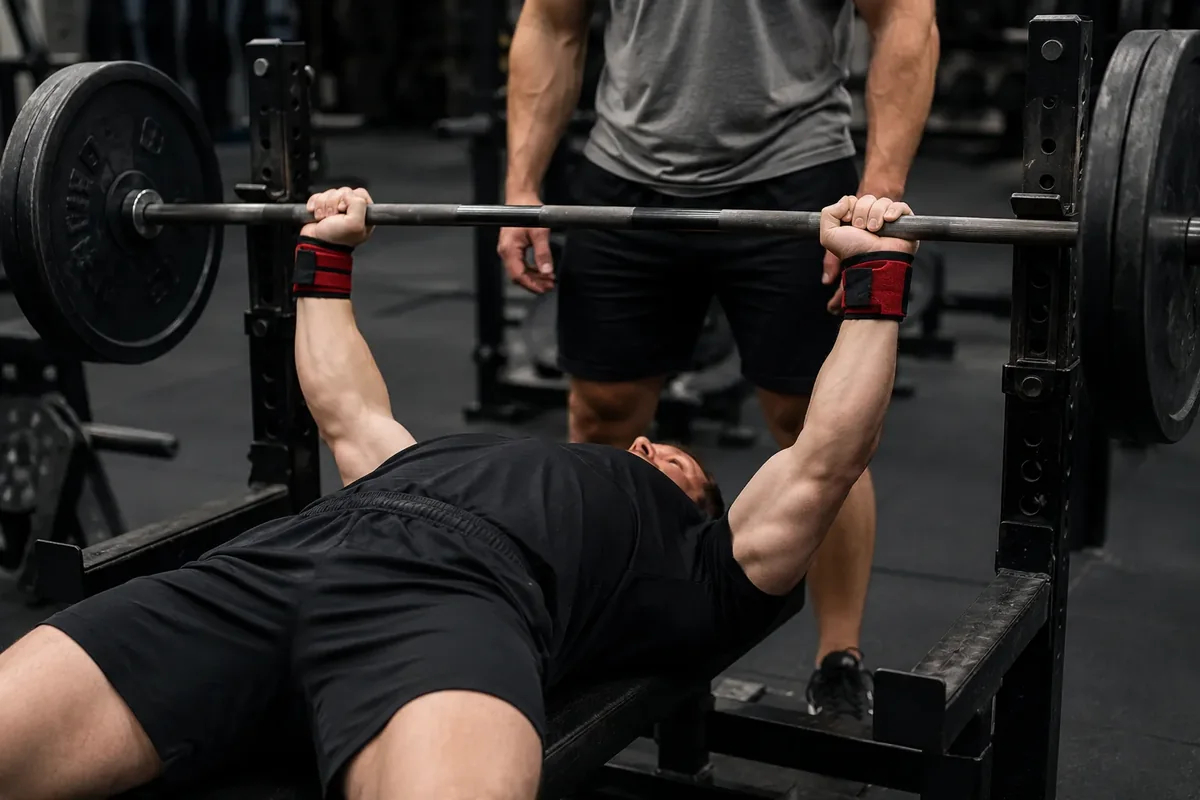
This is where wraps are most commonly useful.
During a heavy bench press, the goal is generally to keep the bar stacked over the wrist and forearm rather than letting the wrist fold dramatically backward.
Place the wrap across the joint.
Grip the bar.
Then look at your wrist from the side.
The bar does not have to sit over a perfectly vertical hand, but you should not see the wrist collapsing uncontrollably underneath it.
If it does, experiment with:
- slightly higher wrap placement;
- more tension;
- a stiffer wrap;
- adjusting where the bar sits in your palm.
Do not immediately assume you need a stronger wrap.
Sometimes the bigger change comes from moving the bar deeper into the hand.
Do Wrist Wraps Help the Deadlift?
Usually not in the way people mean.
Wrist wraps do not attach your hand to the bar.
They do not stop your fingers from opening.
They are not lifting straps.
If grip is limiting your deadlift training, you are looking at a grip issue, hook grip, mixed grip or training straps depending on the purpose of the session and federation rules.
Some lifters may prefer light wrist support for a particular pulling setup, but it should not be confused with grip assistance.
For most powerlifters, wrist wraps are much more relevant to bench and sometimes squat than to deadlift.
Do You Need Wrist Wraps at All?
No.
They are permitted equipment, not mandatory equipment.
If your wrists feel stable and comfortable without them, there is no reason to manufacture a problem just because other lifters have wraps in their gym bags.
They become useful when heavy pressing creates enough wrist extension that additional support improves your setup or comfort.
Newer lifters sometimes buy a belt, sleeves, wraps and straps all at once because those things seem to form the official powerlifting starter kit.
There is nothing wrong with owning them.
Just know why you're putting each item on.
Don't Use Wraps to Ignore Wrist Pain
Support and pain treatment are not the same thing.
A wrist wrap can make a loaded position feel more stable.
That does not mean every painful wrist simply needs to be wrapped tighter.
If you have persistent pain, swelling, a recent injury, sudden loss of strength or symptoms that continue outside lifting, the useful next step is not another layer of Velcro.
Have the problem assessed appropriately.
Gear is great at doing the job gear was designed to do.
It is less useful when asked to diagnose you.
Practice Your Competition Wrap Before Competition
Do not invent a special meet-day wrap five minutes before your bench opener.
Use your intended competition setup during heavy training first.
You should already know:
- where the first pass starts;
- how much tension you like;
- where the Velcro finishes;
- whether you can grip comfortably;
- how long before the attempt you want to put the wraps on;
- how to remove the thumb loops cleanly.
If you use very stiff wraps, this matters even more.
Competition adrenaline is not known for improving fine motor skills.
Make the process boring before meet day.
When Should You Put Them On at a Meet?
Not ten lifters out.
If you wrap very tightly, you probably don't want to sit around with that pressure for several minutes.
Pay attention to the flight order.
When you're close enough that you need to be ready but still have time to finish calmly, put the wraps on.
A handler can help with timing, but this is easy to manage alone once you know how long your normal wrapping routine takes.
The key is to avoid the two extremes:
putting them on so early that your hands are miserable,
or hearing your name while one wrist is still completely unwrapped.
Our First Powerlifting Meet Checklist covers the rest of the meet-day timing and gear routine.
A Quick Wrist Wrap Fit Check
Before your next heavy bench session, try this.
Wrap Across the Joint
Make sure the material actually crosses the wrist rather than sitting entirely on your forearm.
Make a Fist
You should be able to close your hand firmly.
Extend the Wrist
Push the hand backward gently.
You should feel obvious resistance from the wrap.
Grip an Empty Bar
Check whether you can place the bar normally in the palm.
Bench a Warm-Up Set
Notice whether the wrap stays where you put it.
If it slides, folds or loosens, fix that before simply pulling harder.
Check the Thumb Loop
If you're preparing for an IPF meet, practice removing it after securing the wrap.
Make that part of the routine.
Common Wrist Wrap Mistakes
Wrapping Only the Forearm
It looks tidy.
It also misses most of the reason you're wearing wrist wraps.
Cross the joint.
Going Maximum Tightness Every Time
Heavy competition bench and an easy volume session do not necessarily need the same setup.
Use tension according to the lift.
Covering Too Much of the Hand
More hand coverage can create more resistance, but eventually you're interfering with your grip — and in competition, coverage limits apply.
Leaving the Thumb Loop On
Fine while you're securing the wrap.
Not during an IPF attempt.
Take it off before the lift.
Buying by Length Alone
Thirty-six inches tells you how much material there is.
It doesn't tell you how stiff the wrap is, how comfortable it will be or whether the exact model is approved for your meet.
Assuming Every Wrap From an Approved Brand Is Approved
Check the product, not just the logo on it.
The IPF Approved List identifies actual equipment.
What to Check Before an IPF Meet
A week before competition, look at the exact wrist wraps you're planning to use.
Confirm:
- Maximum length does not exceed 1 m
- Width does not exceed 8 cm
- Exact supportive wrap is acceptable under the current IPF approval rules
- Your normal placement stays within the wrist coverage limit
- Thumb loop comes off easily after wrapping
- You are not combining the wraps with sweat bands
- Velcro still holds securely
- Material is in good usable condition
- You've already benched in this exact setup
The current IPF Approved List runs through December 31, 2026.
If you're competing after that approval period, verify the current list again rather than assuming today's status continues automatically.
Official Sources
Frequently Asked Questions
How high should wrist wraps sit?
They should cross the wrist joint and may extend slightly onto the base of the hand.
The useful position is high enough to resist excessive wrist extension without interfering with your grip or exceeding your federation's coverage limits.
How tight should powerlifting wrist wraps be?
Firm enough that you feel clear resistance when the wrist tries to extend.
They should not cause numbness, tingling or make it difficult to close your hand around the bar.
Should wrist wraps go over the wrist joint?
Yes.
If the entire wrap sits below the joint on the forearm, it provides much less direct resistance to wrist extension.
Can you leave the thumb loop on during a powerlifting meet?
Under current IPF rules, no.
The loop may help you put the wrap on, but it cannot remain over the thumb or fingers during the actual lift.
What is the maximum wrist wrap length for IPF?
The current maximum is 1 meter, with a maximum width of 8 cm.
Are 36-inch wrist wraps IPF legal?
A 36-inch wrap is shorter than the one-meter maximum, but size alone does not make a supportive wrap IPF approved. Check the exact product against the current federation requirements.
Can you use 40-inch wrist wraps in IPF?
A true 40-inch wrap is approximately 101.6 cm long, which exceeds the current one-meter IPF maximum.
Can I wear wrist wraps and sweat bands together?
Not under current IPF rules. The rulebook prohibits combining wrist wraps and sweat bands.
Are wrist wraps allowed for squats?
Yes, wrist wraps can be used to support the wrist during squats, subject to the rules of the federation you're competing in.
They are especially common among low-bar squatters who experience significant wrist extension.
Do wrist wraps help your bench press?
They can improve wrist stability and reduce unwanted extension under heavy loads.
They do not press the weight for you, but a more stable connection between the hand and forearm can make a heavy bench setup feel more secure.
Do wrist wraps help deadlift grip?
No. Wrist wraps support the wrist joint; they do not secure your hand to the bar.
Lifting straps serve a different purpose.
The Wrap Should Support the Lift, Not Become the Lift
There is no prize for the most complicated wrist-wrap ritual.
Put the wrap over the joint.
Use enough tension to resist the wrist position you don't want.
Keep enough freedom to grip the bar properly.
And if you're competing, practice the exact setup that satisfies your federation's rules.
Once the bar is in your hands, the wrist wrap should become boring.
That's usually a sign you got it right.