Powerlifting Belt Placement: High vs Low for Squats and Deadlifts
There is no small mark on your torso that says:
PUT BELT HERE.
It would make powerlifting much easier if there were.
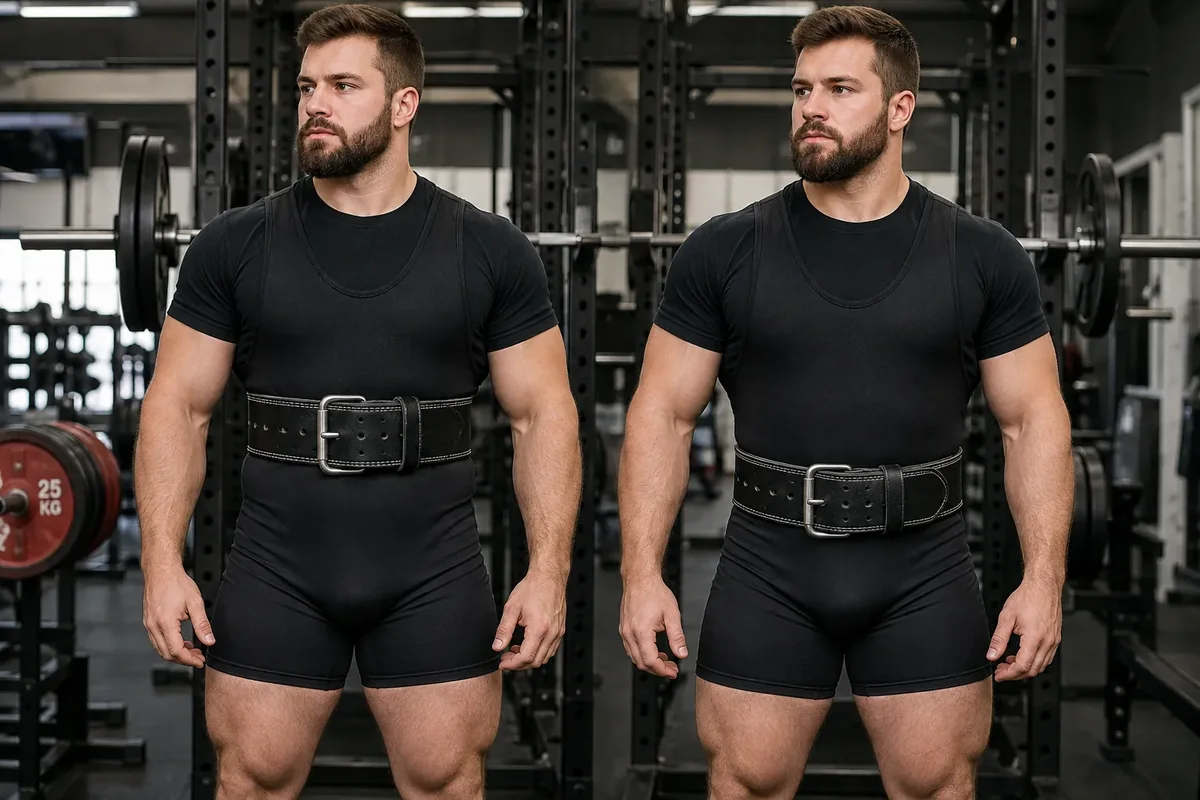
Instead, one lifter wears a belt high enough that the bottom edge barely reaches the top of the hip bones. Another puts the same style of belt much lower. A third wears it one way for squats and moves it two inches for deadlifts.
All three can be doing it correctly.
A powerlifting belt works by giving your trunk something to brace against. Where you place that belt changes what you feel when you take a breath, how much room you have between your ribs and hips, and whether the belt gets in the way when you reach the bottom of a squat or into your deadlift start position.
The best position is not necessarily the one your favorite lifter uses.
It is the one that lets you brace hard without fighting the belt.
Table of Contents
First: What Does a Powerlifting Belt Actually Do?
A lifting belt does not hold your spine in place like an external cast.
You still have to brace.
When you take a large breath and create tension through your trunk, your abdomen expands outward. A stiff belt gives that expansion something to push against.
That can make it easier to create and maintain a strong trunk position under a heavy load.
This is why simply making a belt painfully tight does not automatically make it more useful.
If you cannot get a good breath into your abdomen because the belt is crushing you before the set starts, you may have reduced the very thing you were trying to improve.
Placement works the same way.
A technically perfect powerlifting belt in a position that prevents you from bracing naturally is not a great setup.
Where Is a Powerlifting Belt Supposed to Sit?
A useful starting point is around the middle of your trunk, somewhere between the lower ribs and the top of the pelvis.
For many lifters, the center of the belt ends up roughly around the navel.
But that is a starting point, not a rule.
Your torso may be:
- long;
- short;
- relatively straight;
- narrow at the waist;
- much wider through the ribs;
- wide through the hips;
- somewhere in between.
A four-inch belt takes up the same amount of vertical space whether you have a very long torso or almost no room between your ribs and hip bones.
That is one reason belt placement looks so different from lifter to lifter.
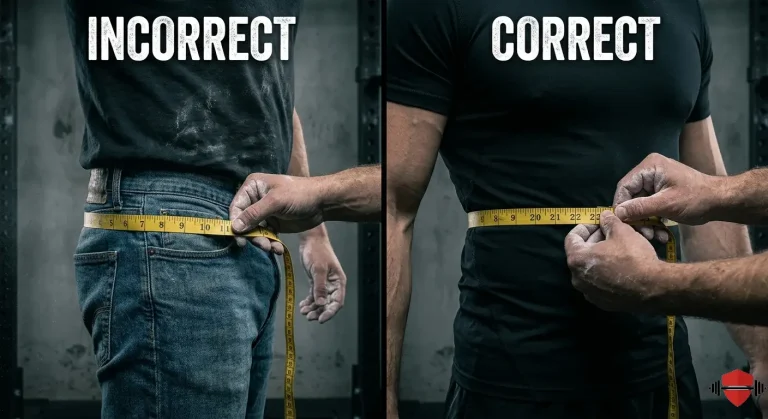
If you are still choosing the actual belt size, start with our Powerlifting Belt Sizing Guide before fine-tuning where the belt sits.
What Counts as “High” Belt Placement?
High belt placement usually means moving the belt farther up the torso, toward the lower ribs.
It does not mean putting it around your chest.
The belt still needs to give you useful abdominal contact.
A high position may leave more room around the hips when you squat or bend toward the bar.
Some lifters also feel they can push their upper abdomen more effectively into a belt worn slightly higher.
This can be especially noticeable on the deadlift, where your torso angle may cause the bottom edge of a lower belt to run directly into the top of the thigh.
What Counts as “Low” Belt Placement?
Low placement moves the belt farther toward the hips.
For some lifters, this creates a stronger feeling of support through the lower abdomen.
It can also feel very secure in a squat, particularly when the belt sits naturally between the ribs and the top of the pelvis without pinching either one.
Move it too low, though, and the bottom edge may hit the hip crease as you descend.
That can be mildly annoying with a narrow stance.
With a deep squat and large thighs, it can become the only thing you think about during the lift.
That is a sign to move it.
There Is No Universal “Correct” Height
This is worth saying clearly because powerlifting technique advice has a habit of turning preferences into laws.
A belt does not have to cover your belly button.
It does not have to sit exactly above it.
It does not have to match the lifter next to you.
Under current IPF rules, the belt has construction and approval requirements and must be worn outside the lifting suit. The rules do not prescribe a specific height on the torso.
So when somebody tells you that a belt is “illegal” because it looks an inch higher than theirs, that is not a useful way to read the rulebook.
The real questions are:
Can you brace?
Can you reach the positions you need?
Does the belt stay in place?
Does it comply with the equipment rules of your federation?
Why Belt Placement Often Changes Between Squat and Deadlift
Squat and deadlift ask your torso to do different things.
In a squat, you start standing.
You descend while the belt has to accommodate hip and knee flexion, torso angle and abdominal expansion.
In a deadlift, you often begin the lift in the position where the belt is most likely to cause interference.
You are already bent toward the bar.
Your thighs may be close to your abdomen.
Your rib cage and pelvis are closer together than when standing.
A belt position that feels fantastic in a squat can suddenly feel like a piece of furniture wedged between your ribs and hip when you reach for a deadlift bar.
That is why moving the belt between lifts is completely normal.
Belt Placement for Squats
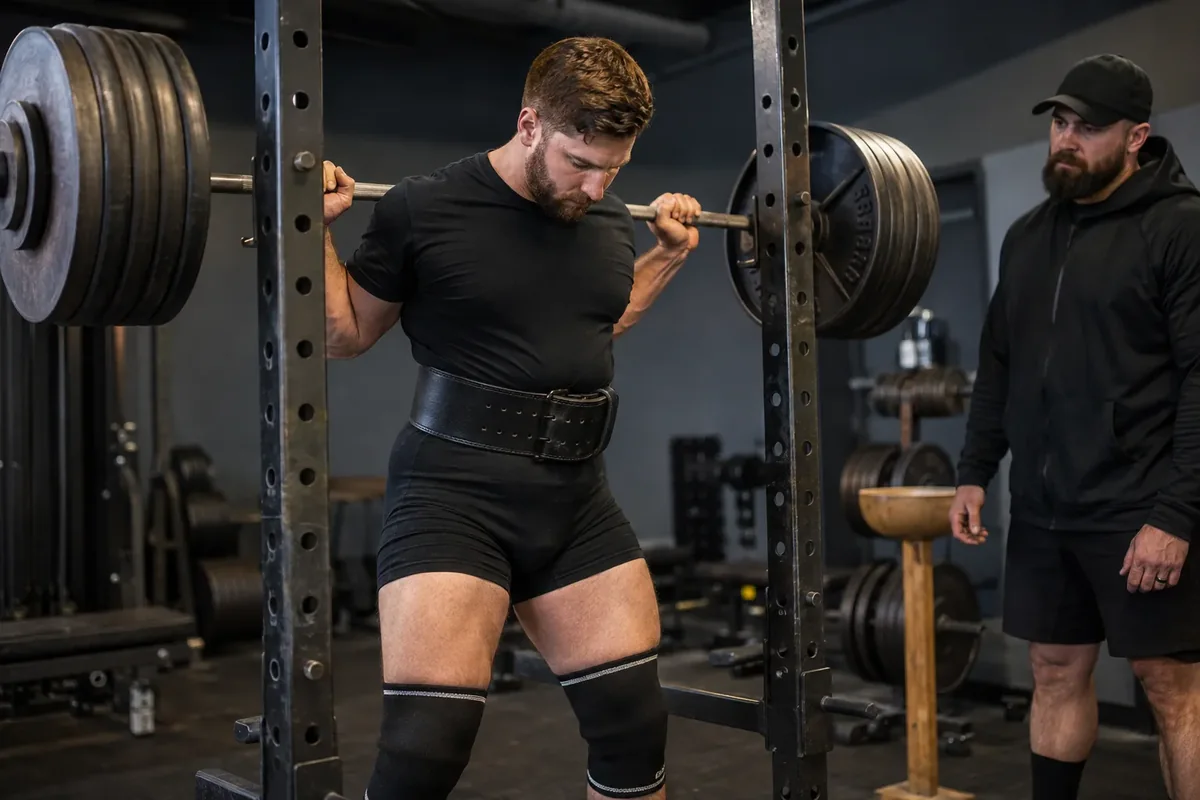
For the squat, start with the belt centered around the natural waist.
Do a few bodyweight squats.
Then a few empty-bar reps.
Pay attention to what happens at the bottom.
The belt should feel like something you can brace into.
It should not feel like something you're trying to escape from.
A Slightly Lower Position Can Feel Very Solid
Some squatters like the belt relatively low because it gives them a strong surface to push the lower abdomen against.
This can feel especially natural for lifters with enough torso space that the belt fits neatly between the ribs and hips.
When it works, the belt tends to stay put through the whole rep.
You breathe.
Brace.
Descend.
Stand back up.
Nothing dramatic happens.
That is generally a good sign.
But Watch the Hip Crease
If the belt is too low, the bottom edge may contact the top of your hip or thigh at depth.
You might notice:
- pinching at the front of the hip;
- the belt being pushed upward during descent;
- difficulty maintaining your normal depth;
- discomfort that disappears as soon as you remove the belt.
Don't immediately assume the belt itself is wrong.
Move it slightly higher and squat again.
An inch can make a surprising difference.
High Belt Placement for Squats
A higher belt position can work well too.
Some lifters prefer the belt closer to the lower ribs because it allows their hips to move more freely at depth.
It may also make sense if you have a short torso and a standard four-inch belt occupies nearly all the space between your ribs and pelvis.
The problem comes when high turns into too high.
If the belt sits mostly on the lower rib cage and you struggle to create abdominal pressure into it, the setup may not be helping much.
You still want meaningful contact with the abdominal wall.
The belt is there to brace into, not simply to decorate the bottom of your ribs.
Low-Bar vs High-Bar Squat: Does It Change Belt Placement?
Sometimes.
A low-bar squat generally uses a different torso angle than a high-bar squat.
That can change what feels comfortable around the waist.
A lifter who leans more in a low-bar position may notice more belt-to-rib or belt-to-hip contact than when squatting more upright.
But there is no automatic rule:
low bar = low belt
or
high bar = high belt.
Those names describe the bar position on your back, not the belt position on your waist.
Test the actual squat.
If changing your bar position changes how the belt feels, adjust from there.
Belt Placement for Conventional Deadlifts
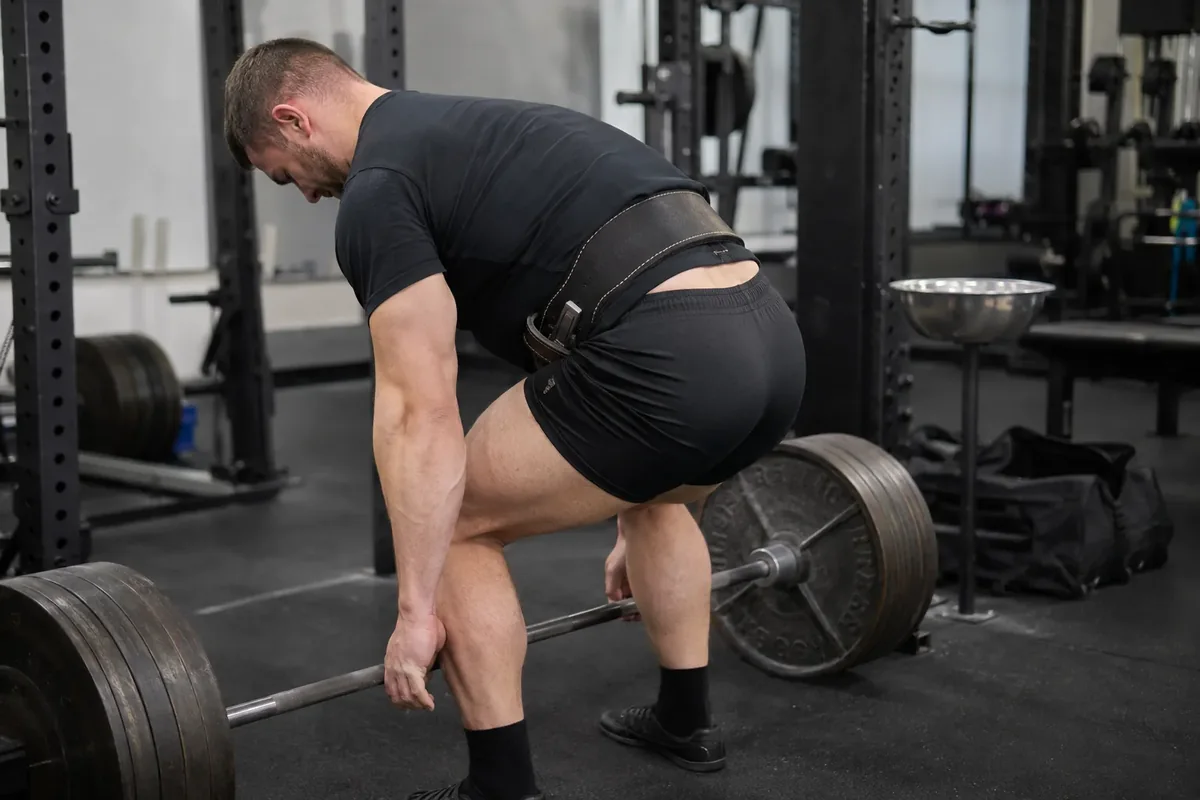
Conventional deadlifts are where a lot of lifters first discover that their squat belt position is not sacred.
Set the belt where you normally squat.
Then walk to the bar and take your deadlift position.
If everything feels normal, excellent.
You may not need to change anything.
If the belt gets trapped between your lower ribs and thighs or makes it difficult to reach the bar, try moving it slightly higher.
This is one of the most common deadlift adjustments.
Why Higher Can Help
Moving the belt up can create more room at the hip crease.
That may let you reach the bar without the bottom edge of the belt being driven into your abdomen or pelvis.
The difference does not have to be large.
Some lifters shift the belt only a small amount between squat and deadlift.
The goal is not to create a completely new technique.
It is to remove interference.
Belt Placement for Sumo Deadlifts
Sumo creates a different problem.
The torso may be more upright, but the hips and thighs take a wide position around the trunk.
Depending on your build, a lower belt can get crowded by the upper thighs at the start.
Again, a slightly higher placement may help.
But not every sumo lifter needs a high belt.
Some have plenty of torso space and prefer the belt lower because that is where they brace best.
Others wear it noticeably higher.
There is no special sumo belt law.
Set up at the bar and see what your body is telling you.
Angling the Belt
The belt does not necessarily have to look perfectly horizontal from every angle.
Some lifters wear it with a slight angle.
For example, the front may sit a little higher than the back, or the reverse.
This can happen naturally because the torso is not shaped like a cylinder.
A slight angle may also help keep an edge away from the ribs or hips.
The important part is that the belt stays secure and gives you a consistent surface to brace against.
If you're constantly rotating it because it feels wrong after every rep, the position probably needs more work.
Should the Buckle Be Centered?
Not necessarily.
A centered buckle is simple and common.
But lever and prong buckles can be bulky, and that bulk may become noticeable during deadlift setup.
Some lifters rotate the buckle slightly off center.
That can move the thickest part of the belt away from an area where it pinches when they bend toward the bar.
If you experiment with this, keep it modest.
You are trying to solve a comfort and positioning problem, not wear the belt sideways around your back.
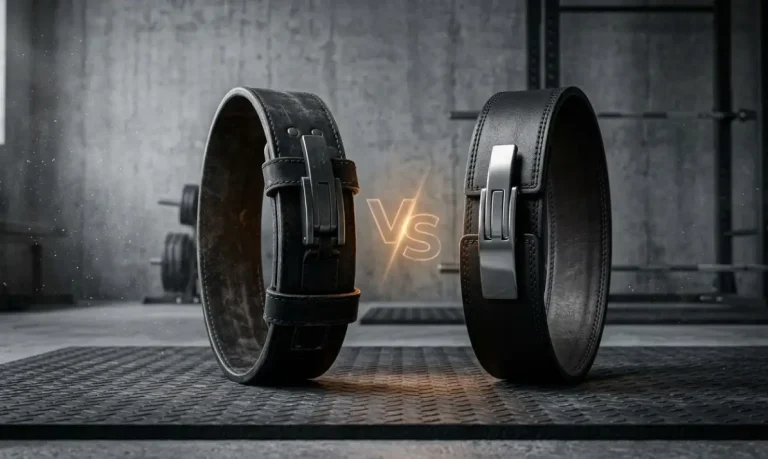
Lever Belt Placement Can Be Less Forgiving
A lever belt gives you a very repeatable circumference.
Close the lever and you get essentially the same setting each time.
That's convenient.
It also means that moving the belt higher or lower on a tapered torso can change how tight it feels.
Suppose your waist is narrower where you squat but slightly wider where you want the belt for deadlifts.
A lever setting that is perfect in one position may feel too tight or too loose in the other.
This is not a defect.
It is geometry.
If you regularly move your belt significantly between lifts, a lever belt may require an adjustment to the lever setting.
Some newer adjustable lever systems make this easier.
A standard lever usually requires repositioning the hardware.
If you are still choosing a buckle style, our Lever vs Prong Powerlifting Belts comparison covers the practical differences.
Prong Belts Make Position Changes Easier
A prong belt gives you holes.
That makes small circumference changes straightforward.
If the higher deadlift position needs one hole looser than your squat position, you can simply use another hole.
This is one of the practical advantages of a prong belt for lifters whose bodyweight or preferred placement changes frequently.
It does not make prong belts inherently better.
It just means the adjustment is built into the design.
How Tight Should the Belt Be?
Placement and tightness are connected.
A position that feels too tight may simply be a wider section of your torso.
Before moving the belt, check whether you need a different hole or lever setting.
For most powerlifting use, the belt should be tight enough that you can create strong pressure into it but loose enough to take the breath you actually use for lifting.
Try this:
Put the belt on.
Take a full breath.
Expand your abdomen into the front, sides and back of the belt.
Brace hard.
If the belt gives you a strong surface to push against, good.
If you cannot take the breath in the first place, loosen it.
If you take a full breath and the belt barely makes contact, tighten it.
The goal is not to see how many discomfort points you can collect before touching the bar.
Why Short-Torso Lifters Often Struggle With 4-Inch Belts
A standard powerlifting belt is commonly around four inches wide, which is close to the IPF maximum width of 10 cm.
For someone with a long torso, that can leave plenty of room.
For someone with very little space between the lower ribs and top of the pelvis, the same belt can feel enormous.
It may contact the ribs at the top and hips at the bottom simultaneously.
If that sounds familiar, placement changes may help.
But sometimes the answer is simply a narrower belt.
A three-inch belt can be much easier to position on a short torso while still providing a substantial surface to brace into.
You do not get extra points for using the widest belt you can legally wear.
Fit comes first.
Larger Lifters May Need to Experiment More With Angle
A belt sitting around a larger abdomen does not always want to stay perfectly horizontal.
That is normal.
Your goal is consistent pressure, not creating a straight line for a photo.
Try the belt:
- slightly higher;
- slightly lower;
- with a small angle;
- one setting tighter;
- one setting looser.
Then actually lift.
Standing in front of the mirror only tells you how the belt feels while standing in front of a mirror.
That is not one of the competition lifts.
Should Women Wear a Belt Differently?
There is no separate universal belt position for women.
The same principles apply.
Torso length, rib position, hip structure, abdominal shape and lifting style matter much more than a generic male/female belt rule.
A lifter with a shorter torso may prefer a narrower belt.
A lifter with more space between the ribs and hips may be comfortable with a standard four-inch model.
Test the position during the actual lift.
The belt doesn't care what section of the size chart your name appears under.
Does Bodyweight Change Belt Placement?
It can.
A belt position you loved 20 pounds ago may no longer feel the same.
The opposite can happen after weight loss.
Changes in waist circumference and abdominal shape can affect both:
- the circumference setting;
- where the belt naturally wants to sit.
This is especially noticeable with a fixed lever position.
If your belt suddenly feels strange after a meaningful bodyweight change, do not assume your technique has deteriorated.
Reset the equipment.
Find the position again.
Belt Placement for Bench Press
A belt is optional on bench press.
Some lifters like wearing one.
Others don't.
If you bench in a belt, placement is usually about staying out of the way of your arch and setup.
A position that is comfortable when standing can feel different once you retract your shoulders, arch and plant your feet.
The belt should not prevent you from getting into your normal competition position or interfere with breathing.
For some lifters, a slightly lower or looser position feels better on bench.
Others simply use their squat setting.
And plenty of lifters bench without a belt at all.
There is no need to invent a benefit you cannot feel.
A Simple Way to Find Your Squat Belt Position
Do this during a normal training session, not the week of your meet.
Start at Your Natural Waist
Center the belt roughly around the navel area.
Use your normal tightness.
Squat With an Empty Bar
Pay attention to the ribs and hip crease.
Add Moderate Weight
A position that feels fine with an empty bar may change once you're bracing hard.
Use a load heavy enough to make you brace normally but light enough that experimenting is safe.
Move the Belt Up Slightly
You do not need a huge adjustment.
Try about an inch.
Repeat the set.
Move It Down
Do the same in the other direction.
Compare the Actual Lift
Ask:
Where could I brace hardest?
Where did the belt stay in place?
Where did it interfere least at depth?
That is more useful than asking which position looked most like somebody else's Instagram clip.
A Simple Way to Find Your Deadlift Belt Position
The process is even easier.
Put on your normal squat setting.
Walk to the bar.
Get into your deadlift start position.
Before you pull, ask yourself whether the belt is helping or physically blocking the setup.
If it is digging into the ribs, hips or thighs, stand up.
Move it.
Try again.
You can test several positions with an empty bar or warm-up weights without wasting a deadlift session.
Once one position clearly feels better, use it consistently long enough to decide whether it actually improves your setup.
Don't Change Three Things at Once
This is a good rule for almost every powerlifting equipment problem.
If you change:
- belt height;
- tightness;
- buckle position;
- stance;
- breathing style;
all at the same time, you will have no idea which change mattered.
Move the belt first.
Lift.
Then adjust tightness if needed.
Lift again.
Powerlifting experimentation is not exciting.
That is why it works.
Common Belt Placement Mistakes
Copying Another Lifter Exactly
Their torso is not your torso.
Use their setup as an idea, not a measurement.
Wearing It Low Because “Low Is Stronger”
Sometimes low feels excellent.
Sometimes it crashes into your hip crease.
Your squat will answer the question quickly.
Wearing It High Because a Good Deadlifter Does
The same problem in reverse.
A high belt is useful only if you can brace into it.
Making the Belt Extremely Tight to Stop It Moving
If the belt moves during every rep, the problem may be placement.
Crushing yourself harder is not always the answer.
Refusing to Move It Between Lifts
Your squat and deadlift positions are different.
There is no award for keeping the buckle on the same patch of skin all day.
Changing Placement on Meet Day
If you have never pulled with the belt high, your third deadlift warm-up at a competition is not a great time to discover whether you like it.
Test the setup during training.
What Do IPF Rules Say About Belt Placement?
The current IPF Technical Rulebook allows competitors to wear a belt and requires it to be worn outside the lifting suit.
For IPF competition, approved-belt requirements also apply.
Current maximum belt dimensions include:
- 10 cm width
- 13 mm thickness along the main length
The rulebook also sets dimensions for the buckle and tongue loop.
What it does not do is tell every lifter to place the belt at one specific vertical point on the torso.
That means your high-versus-low choice can be based on bracing and movement, as long as the belt itself and the way you wear it comply with your federation's rules.
If you compete outside the IPF system, check that federation's current equipment rules rather than assuming they are identical.
For a broader competition-equipment check, see our IPF Approved List 2026 guide.
Your Competition Belt Position Should Already Be Boring
By meet week, you should know where your belt goes.
You should not need to stand in the warm-up room deciding whether today's squat feels like a high-belt day.
A good routine is repeatable.
For example:
Squat: center buckle, normal waist position, fourth hole.
Bench: same position, one hole looser.
Deadlift: one inch higher, buckle slightly off center, third hole.
Your routine may be completely different.
The point is that you know it.
When attempt day comes, there are enough variables already.
Belt placement does not need to be another one.
If this is your first competition, pair this with the First Powerlifting Meet Checklist.
Quick Belt Placement Checklist
Before settling on a position, check the actual lift.
- Can you take a full competition breath?
- Can you expand your abdomen into the belt?
- Does the belt stay reasonably stable during the rep?
- Does the upper edge avoid painful rib contact?
- Does the lower edge avoid the hip crease and thighs?
- Can you reach normal squat depth?
- Can you reach your deadlift start position without fighting the belt?
- Does the buckle stay out of the way?
- Have you tested the position under meaningful training load?
- Have you practiced the same setup you plan to use at the meet?
If the answers are yes, the belt is probably in a useful place.
Official Sources
Frequently Asked Questions
Should a powerlifting belt sit above or below the belly button?
There is no universal requirement.
Around the navel is a useful starting point, but lifters may wear the belt somewhat higher or lower depending on torso shape, lift and bracing preference.
Is high or low belt placement better for squats?
Neither is automatically better.
A lower position may give some lifters strong lower-abdominal pressure, while a higher position may provide more hip clearance.
Use the position that lets you brace hard and squat to depth without the belt interfering.
Should I wear my belt higher for deadlifts?
Many lifters do because a higher position can create more room between the belt and the hips or thighs in the start position.
But it is not required.
If your squat position works well for deadlifts too, there is no reason to move it simply because other lifters do.
Can I wear my belt differently for squat and deadlift?
Yes.
It is completely normal to change the height, tightness or buckle position between lifts.
Can a powerlifting belt touch your ribs?
A belt may sit close to the lower ribs, especially on a short torso.
If it causes painful pinching when you brace or bend, try moving the belt or consider a narrower model.
Why does my belt pinch my hips when I squat?
It may be sitting too low for your torso and squat position.
Try moving it slightly higher before assuming the entire belt is the wrong size.
Why does my belt hurt when I deadlift?
A belt can get compressed between the ribs, abdomen, pelvis and thighs in the deadlift start position.
Experiment with a higher position, slightly different angle or different tightness.
Should a belt be tighter for squat or deadlift?
There is no required difference.
Some lifters prefer the same setting, while others use a slightly different circumference because they move the belt to a different part of the torso.
Can I rotate the buckle off center?
A small amount of rotation is commonly used when the buckle gets in the way during setup.
The important thing is that the belt remains secure and complies with your federation's rules.
Is a 3-inch belt better for a short torso?
It can be.
If a standard four-inch belt constantly contacts both the ribs and hips, a narrower belt may give you more room without eliminating the surface you brace against.
Does IPF require the belt to cover the belly button?
No. The current IPF rules specify belt construction, dimensions, approval and that it be worn outside the lifting suit, but they do not prescribe one exact vertical location on every lifter's torso.
The Best Belt Position Is the One You Stop Thinking About
You should feel the belt when you brace.
You should not spend the entire rep thinking about where the belt is.
That is a useful distinction.
Start around your natural waist.
Squat.
Deadlift.
Move the belt slightly and try again.
Give yourself enough time to decide based on actual lifting rather than how the setup looks in a mirror.
You may end up wearing it low for everything.
You may wear it high for everything.
You may have a squat position and a completely different deadlift position.
None of those outcomes is strange.
The belt is supposed to fit your lift.
Your lift is not supposed to fit the belt.